
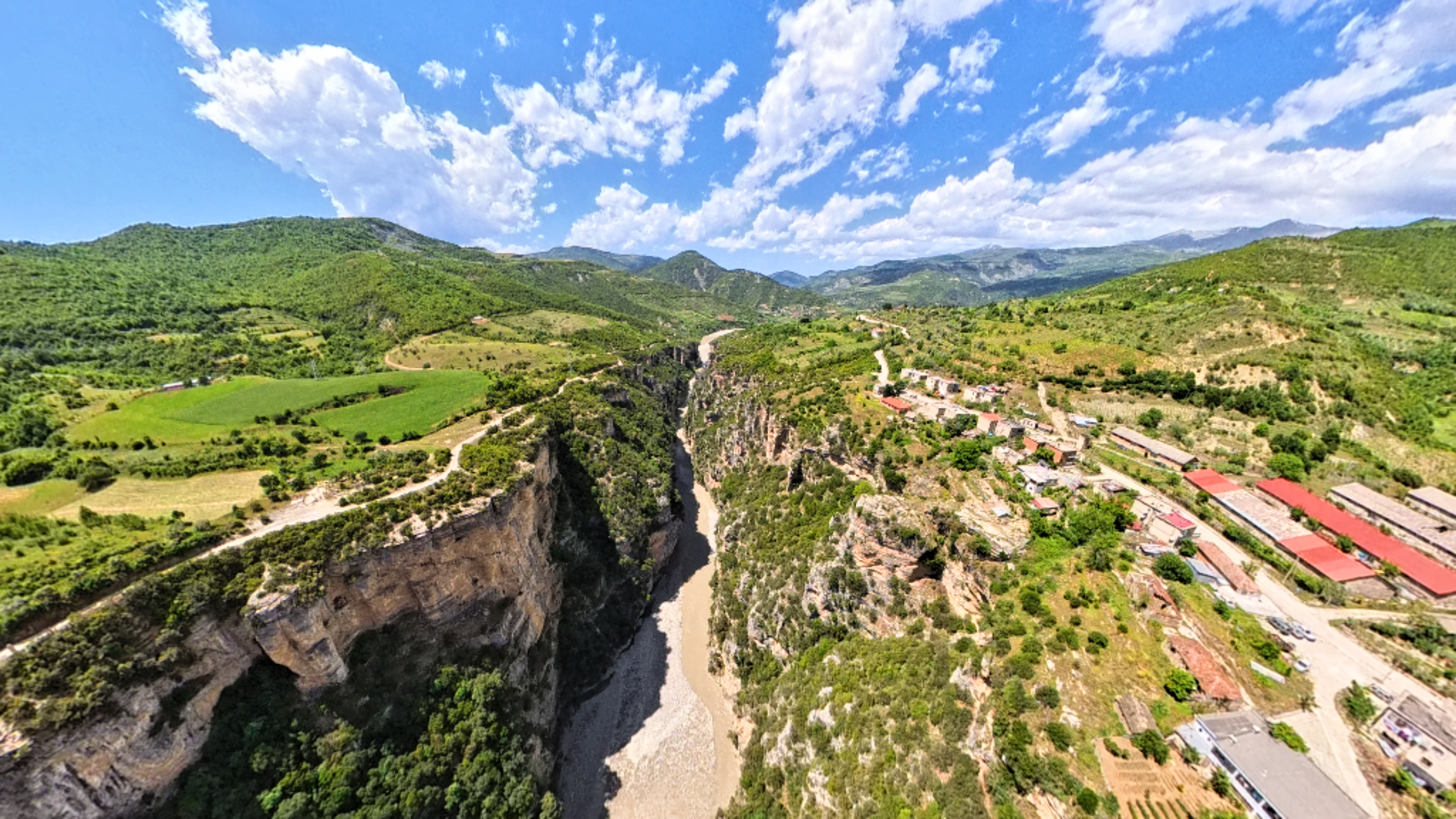
From the drone, Osumi Canyon looks almost impossible.
The stone walls, the turquoise water, the curves of the river, and that kind of landscape that feels like it should be watched in silence. But there is something the aerial view cannot fully explain.
You can watch the short video from this Osumi Canyon rafting experience on Instagram.
I understood it later, when I was already inside the bus, watching the road toward the canyon from a first-person view. Before we even reached the water, the experience had already begun.
It did not start with the paddle.
It started with the way someone welcomes you, with the driver greeting you naturally, with people getting ready, with that small shift in energy that happens when a group realizes they are about to enter somewhere bigger than themselves.
Some experiences are not built only with scenery. They are built with rhythm.
Osumi Canyon does not need much explanation. You just have to be there. Look up. Feel the walls rising on both sides of the raft. Listen to the water. Watch a waterfall appear between the rocks. Notice how people slowly stop thinking about the camera and simply start laughing when the river begins to move.
I like that shift.
Because in travel, there is a moment when you stop looking at an experience and start being inside it.
On the raft, everything becomes simpler: the paddle in your hand, the guide setting the rhythm, the water coming in, someone laughing, someone watching quietly, someone filming because they already know they will want to remember that moment later.
And still, what interested me most was not only the adrenaline.
It was seeing how an experience like this depends on many things the traveler does not always notice: the transport, the equipment, the safety briefing, the coordination, the tone of the guide, the place where the day begins, the place you return to, the food, the showers, and the feeling that someone had thought through the whole day before you arrived.
For me, that is also hospitality.
Not hospitality as luxury or formality, but as care. As an operation that allows the guest to relax, enjoy, and trust.
Rafting in Osumi can be seen as an adventure activity. And yes, it is. There is water, movement, emotion, and landscape. But when you live it from the inside, you understand that the value is not only in going down the river.
It is in how the whole day is built.
In Berat, that difference matters. Many people arrive looking for an activity, a photo, or a day trip. But they leave with something wider: another way of understanding Albania. Wilder, closer, more human.
Albania still has the strength of places that have not been completely packaged. Osumi Canyon carries that feeling. It does not feel like an attraction manufactured for tourists. It feels like a vast landscape you enter with respect, guided by people who know the river and understand when to speed up, when to wait, and when to let the place speak for itself.
If you go, my recommendation is simple: do not experience it only through the camera.
Film, yes. Take photos. The place deserves it. But also keep a few moments without a screen. Look up when the raft enters between the canyon walls. Listen to the water as it moves around the rocks. Watch the team. Notice how the energy of the group changes after the first waterfall.
That is where an important part of the journey lives.
I went to Osumi Canyon to experience an activity. I came back with a clearer idea: a good adventure experience does not depend only on the landscape, but on the way someone cares for it from beginning to end.
And when that happens, the tour stops being just a tour.
It becomes a day that stays with you.
Written by Ignacio Suarez, a traveler and hospitality builder exploring Albania from the inside.
You can follow more of the journey on Instagram: @ignachotravel


